The West doesn’t lose its wars. It declines to win them.
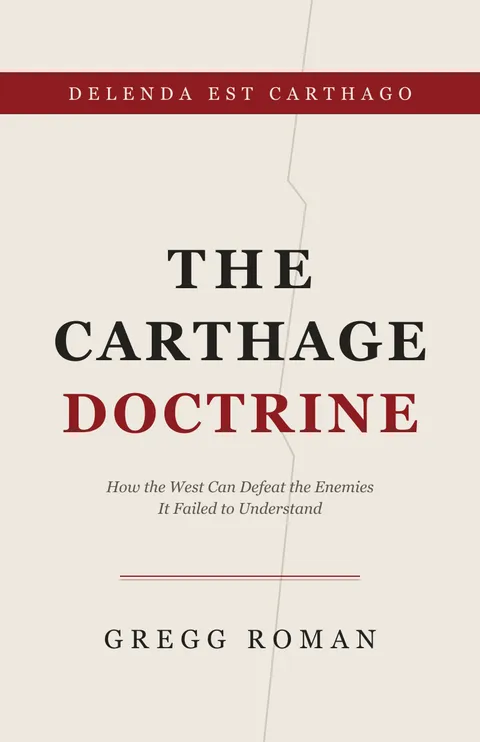
The Carthage Doctrine — How the West Can Defeat the Enemies It Failed to Understand
The Argument
The West keeps mistaking management for strategy — deterring, containing, negotiating, while its enemies plan for victory. Gregg Roman fought that failure from the inside: the IDF, Israel’s Ministry of Defense, the West Point classroom, the front lines of the information war. Part memoir, part doctrine, The Carthage Doctrine argues that decisive victory is a choice — and lays out exactly what choosing it demands.
For two generations the West has fought wars it refused to finish. Deterrence, containment, proportional response, ceasefire and rebuild — an entire vocabulary invented to avoid the word victory, deployed by governments that mistake managing a conflict for ending one. The enemies of free nations have never made that mistake.
The Carthage Doctrine is the argument that conflicts end in decisive victory or they do not end — told by someone who learned it the hard way.
Part I is the education: an American suburb, an ocean crossed, an IDF uniform, the inside of Israel’s Ministry of Defense during the war after the war, the day the peace process died, the $122 million scandal, the head of the octopus. Part II is the doctrine those years produced — defined, defended, and applied: what victory actually requires, why Israel’s post–October 7 choices are the test case of the century, how the information war and the lawfare campaign are theaters of the same conflict, and what a Pax built by winners looks like when the West finally decides to build one.
Cato the Elder ended every speech the same way, whatever the subject: Carthage must be destroyed. He was not bloodthirsty. He was serious. This book is about what it means to be serious.
Prologue — Ninety Seconds
“You have ninety seconds, and you count them, because counting is the one thing you can control.”
Why I wrote this
Part I of this book is my life: a suburban American kid who crossed an ocean to find the truth, put on another country’s uniform, worked inside its Ministry of Defense, and watched — from inside the rooms — as the peace process failed and the same comfortable delusions survived every disaster intact. Part II is what that life taught me. Conflicts end when one side wins and the other side knows it. Everything else is management, and management is how free nations lose slowly while calling it stability. I wrote the doctrine down because someone who has operated should — before the next ninety seconds arrive.
— Gregg Roman
Preorder — arriving October 2026
Be first when the doctrine drops.
The Carthage Doctrine: at a glance
The West doesn’t lose its wars. It declines to win them.
- Written before the war it predicted, read after it — opens with the author counting to ninety on a shelter floor with his children, and closes by auditing the thirty-nine-day war against his own doctrine.
- A doctrine with hard benchmarks, not slogans — four verifiable victory conditions, the force-versus-victory distinction, and an operational rule separating ideology from population.
- Part memoir, part field manual — two decades from the IDF and the deputy foreign minister’s office to the investigation that exposed over $122 million in taxpayer grants to terror-linked organizations, ending with a three-pillar post-victory framework and “Ten Ways to Fight in the Narrative War.”
- Publication
- October 2026
- Categories
- Current affairs · National security · Memoir
- For readers of
- Victor Davis Hanson’s The Case for Trump-era strategy writing · Michael Doran’s policy essays · Edward Luttwak’s Strategy
- Why now
- Publishes October 2026, as the ceasefire debates and the next Iran question dominate the policy agenda.